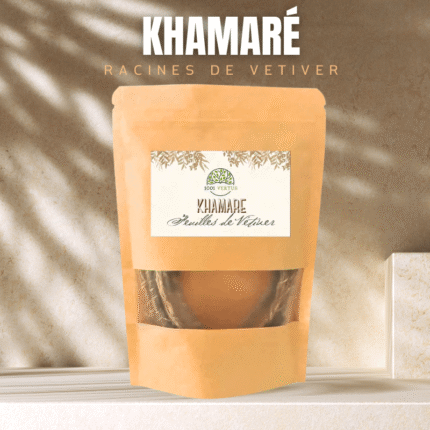
10 Khamaré Stems (Vetiver Roots)
9,90 €
In stock
10 Khamaré stems with a delicate, woody aroma, suitable for hot or cold infusions to make a traditional, naturally aromatic drink.
- 100% natural & unprocessed
- Reusable up to 5 times
- Hot or cold infusion
- West African tradition
In stock
What is Khamaré, also known as vetiver roots or stems?
Let’s start by introducing the many names of this plant, known for its numerous benefits. You may find it under the exotic name Khamaré, but also as vetiver stems or roots, as well as the gentle-sounding names Gongoli or Sodhoré. Originally from West Africa, its name varies depending on the region. However, the many benefits attributed to it remain the same.
In appearance, it is a plant with green roots that grows in tall clumps. It can reach a height of 2 to 3 metres! At the same time, vetiver roots can extend up to 4 metres into the ground. That’s quite impressive!
Benefits of Khamaré Roots
Khamaré roots are traditionally used in West Africa, particularly in the form of flavoured water or infusions:
- Antimicrobial properties: the roots and their essential oil have been studied for their activity against certain bacteria and fungi. (1)
- Antioxidant properties: several studies have examined the compounds found in Khamaré for their activity against oxidative stress. (2)
- Digestive comfort: the roots are traditionally used to support digestion and soothe certain digestive discomforts. (3)
- Women’s well-being: Khamaré plays an important role in certain traditional women’s practices in West Africa. However, specific effects on the menstrual cycle, fertility, breastfeeding or intimate health have not been clinically demonstrated. (4)
Please note: scientific evidence on Khamaré remains limited and comes mainly from laboratory studies and ethnobotanical surveys. This evidence is not a substitute for a diagnosis, consultation with a healthcare professional or medical treatment.
Notes
(1) Antimicrobial properties
- Champagnat P, Sidibé L, Forestier C, Carnat A, Chalchat JC, Lamaison JL. Antimicrobial Activity of Essential Oils from Vetiveria nigritana and Vetiveria zizanioides Roots. Journal of Essential Oil Bearing Plants. 2007;10(6):519-524. doi:10.1080/0972060X.2007.10643589.
- Semde Z, Koudou J, Zongo C, Figueredo G, Somda MK, Ganou L, Traore AS. Chemical composition, antioxidant and antimicrobial activities of the essential oil of Vetiveria nigritana (Benth.) Stapf roots from Burkina Faso. Journal of Applied Biology & Biotechnology. 2017;5(4):29-36. doi:10.7324/JABB.2017.50405.
- Karou SD, Tchacondo T, Djikpo Tchibozo MA, et al. Screening Togolese medicinal plants for few pharmacological properties. Pharmacognosy Research. 2012;4(2):116-122. doi:10.4103/0974-8490.94737.
(2) Antioxidant properties
- Mbodj M, Gaye AA, Samb I, Gaye ML. Phytochemical Study and Evaluation of the Antioxidant Activity of Extracts of the Roots of Chrysopogon nigritanus. European Journal of Medicinal Plants. 2023;34(3):12-21. doi:10.9734/EJMP/2023/v34i31126.
- Diop A, Karé M, Samb I, Gaye ML. Extraction, caractérisation et évaluation de l’activité antioxydante de l’huile de Chrysopogon Nigritanus. Afrique Science. 2023;22(3):23-33.
- Semde Z, Koudou J, Zongo C, et al. Chemical composition, antioxidant and antimicrobial activities of the essential oil of Vetiveria nigritana (Benth.) Stapf roots from Burkina Faso. Journal of Applied Biology & Biotechnology. 2017;5(4):29-36.
(3) Digestive comfort
- Adamu HM, Abayeh OJ, Agho MO, Abdullahi AL, Uba A, Dukku HU, Wufem BM. An ethnobotanical survey of Bauchi State herbal plants and their antimicrobial activity. Journal of Ethnopharmacology. 2005;99(1):1-4. doi:10.1016/j.jep.2004.12.025.
- Semde Z, Koudou J, Zongo C, et al. Chemical composition, antioxidant and antimicrobial activities of the essential oil of Vetiveria nigritana (Benth.) Stapf roots from Burkina Faso. Journal of Applied Biology & Biotechnology. 2017;5(4):29-36.
(4) Traditional uses of Khamaré
- Ouoba AMA, Sama H, Derra AN, Guenné S, Hilou A. Variability of ethnobotanical uses and biological activities of three aromatic plants from three regions of Burkina Faso: Acanthospermum hispidum DC; Vitex simplicifolia Oliv. and Vetiveria nigritana (Benth). BMC Complementary Medicine and Therapies. 2026;26. doi:10.1186/s12906-026-05490-4.
- Adamu HM, Abayeh OJ, Agho MO, et al. An ethnobotanical survey of Bauchi State herbal plants and their antimicrobial activity. Journal of Ethnopharmacology. 2005;99(1):1-4.
Finally, if you have never used Khamaré before, you should know that it also has the advantage of being able to be stored for many years.
Informations
Informations complémentaires
| Weight | 0,12 kg |
|---|
How to Use Khamaré?
Khamaré is traditionally consumed as an infusion or flavoured water, either hot or cold. Before use, simply rinse the roots with clean water.
- Hot infusion: place 1 to 3 stems in hot water and leave to infuse for a few minutes before drinking.
- Cold infusion: add 1 to 3 stems to a bottle or jug of water and leave to infuse in the fridge for approximately 24 hours.
- Daily use: Khamaré water can be enjoyed gradually throughout the day, according to your usual habits.
- Reuse: the same roots can be used several times, up to approximately 5 uses, as long as they retain their aroma and appearance.
- Storage: keep unused roots in a dry place, away from moisture, ideally in an airtight bag or container.
Khamaré naturally has a distinctive woody aroma that is gradually released into the water.
Where Do Vetiver Stems Come From?
Originally, Khamaré comes from India and Sri Lanka. However, it has been introduced to many tropical countries. Today, its cultivation has spread to almost all tropical regions. It can therefore be easily found in India, China and Malaysia, among other countries.
It is also found in Haiti, the Indian Ocean region and Southern Africa. This is simply because vetiver roots grow mainly in warm, humid environments.
Related products