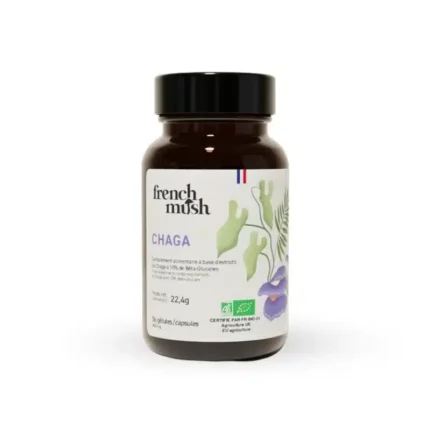
Chaga – 56 Capsules
Price range: 32,00 € through 89,00 €
In stock
Particularly valued for its richness in antioxidant compounds, Chaga is available here as a concentrated extract to maximise the intake of active ingredients naturally found in the mushroom.
- Concentrated 10:1 organic extract, 400 mg per capsule
- 9% beta-glucans + standardised inotodiol and betulinic acid content
- Derived exclusively from wild fruiting bodies harvested from birch trees
- Ultrasonic extraction & independent laboratory testing
The Treasure of Boreal Forests
Chaga (Inonotus obliquus) is an adaptogenic mushroom that grows wild on the bark of birch trees in cold regions such as Finland, Siberia and Canada.
Only organic strains of Finnish origin are selected, and the extract is then obtained through ultrasonic extraction: a gentle method that preserves the active compounds and guarantees 92% bioavailability.
The result is a concentrated extract standardised to:
- 10% beta-glucans
- 0.5% betulinic acid
- 0.3% ergosterol
- 2% inotodiol, a triterpene exclusive to Chaga
Each capsule contains 400 mg of extract derived entirely from the fruiting body; two capsules therefore provide 800 mg of pure active ingredients.
Active Ingredients in Chaga
Here are some of the potential benefits associated with Chaga, based on the available scientific literature:
- Has powerful antioxidant properties that help combat oxidative stress (1)
- Contains polysaccharides and beta-glucans with immunomodulatory potential (2)
- Has anti-inflammatory potential linked to various bioactive compounds (3)
- May help maintain a balanced gut microbiota and support the intestinal barrier (4)
- Shows potential protective effects against certain types of oxidative liver damage (5)
Please note: these points are not health claims but are provided for informational purposes only, based on the available scientific evidence. Research on Chaga is still mainly conducted in vitro or using animal models, and clinical data in humans remain limited. Nothing replaces a consultation with your doctor, and you should not replace any medical treatment with this product or any other.
Notes
(1) Antioxidant properties
- Cui Y, Kim DS, Park KC. Antioxidant effect of Inonotus obliquus. Journal of Ethnopharmacology. 2005;96(1-2):79-85. (strong antioxidant activity)
- Hwang BS, Lee IK, Yun BS. Phenolic compounds from the fungus Inonotus obliquus and their antioxidant properties. Journal of Antibiotics. 2016;69(2):108-110. (antioxidant phenolic compounds)
- Lu Y, et al. Recent Developments in Inonotus obliquus Polysaccharides: Isolation, Structural Characteristics, Biological Activities and Application. Polymers. 2021;13(9):1441. (preclinical review)
(2) Immunomodulatory potential
- Won DP, et al. Immunostimulating activity by polysaccharides isolated from fruiting body of Inonotus obliquus. Molecules and Cells. 2011;31(2):165-173. (activation of immune cells)
- Fungal polysaccharides from Inonotus obliquus are agonists for Toll-like receptors and induce macrophage anti-cancer activity. 2024. (macrophage activation)
- Inonotus obliquus Polysaccharides: Preparation, Structural Characteristics, Structure-Activity Relationships, Biological Activities and Applications. Nutrients. 2026. (immunomodulatory potential)
(3) Anti-inflammatory potential
- Park YM, et al. In vivo and in vitro anti-inflammatory and anti-nociceptive effects of the methanol extract of Inonotus obliquus. Journal of Ethnopharmacology. 2005;101(1-3):120-128. (reduced inflammation in animals)
- Shen D, et al. In Vitro Immunomodulatory Effects of Inonotus obliquus Extracts on Resting M0 Macrophages and LPS-Induced M1 Macrophages. 2022. (modulation of inflammatory mediators)
(4) Gut microbiota and intestinal barrier
- Liu S, et al. Inonotus obliquus polysaccharide are linear molecules that alter the abundance and composition of intestinal microbiota in Sprague Dawley rats. Frontiers in Nutrition. 2023;10:1231485. (changes in gut microbiota)
- Zhang J, et al. Polysaccharide from fermented mycelium of Inonotus obliquus attenuates the ulcerative colitis and adjusts the gut microbiota in mice. Microbial Pathogenesis. 2023;177:105990. (gut microbiota and intestinal inflammation)
- Sun R, et al. Mushroom polysaccharides from Grifola frondosa and Inonotus obliquus ameliorated dextran sulfate sodium-induced colitis in mice by global modulation of systemic metabolism and the gut microbiota. Frontiers in Pharmacology. 2023;14:1172963. (modulation of gut microbiota)
(5) Protection against oxidative stress in the liver
- Hong KB, et al. Hepatoprotective Activity of Water Extracts from Chaga Medicinal Mushroom, Inonotus obliquus, Against Tert-Butyl Hydroperoxide-Induced Oxidative Liver Injury in Primary Cultured Rat Hepatocytes. International Journal of Medicinal Mushrooms. 2015;17(11):1069-1076. (protection of liver cells)
Why Choose Our Chaga Over Others?
Because it brings everything together: certified high concentration, clean extraction, exceptional bioavailability and transparent quality testing.
Most conventional powders offer 30–50% absorption; ours reaches 92%, providing up to 3 times greater measurable effectiveness.
The result: you can enjoy its antioxidant, immune-supporting and beauty benefits more quickly.
How to Optimise Your Routine
Informations
Informations complémentaires
| Weight | N/A |
|---|---|
| Format : | 1 Boite (1 mois), 2 Boites (2 mois), 3 Boites (3 mois) |
How to Include Chaga in Your Routine
Recommended dose: 2 capsules per day, in the morning with a large glass of water, providing 800 mg of extract.
Regular use for 60 to 90 days is ideal for establishing lasting benefits.
Contraindications
Not recommended for children, pregnant or breastfeeding women, or people allergic to birch; medical advice is recommended for those taking anticoagulant medication.
Related products

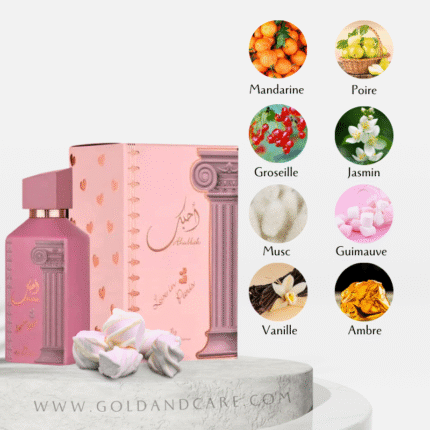
Ahubbak Love in Paris 100 mL (Ard Al Zaafaran) Eau de Parfum