

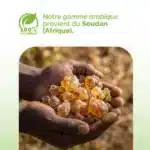

Sudanese Gum Arabic – 100 g (Acacia Gum)
7,90 €
In stock
100 g of raw gum arabic pieces from Sudan, offering a natural ingredient used since ancient times that is easy to incorporate into everyday life.
- 100% natural & pure, with no additives
- Rich in soluble fibre
- Infusions, food preparations & cosmetic use
In stock
Gum arabic pieces, also known as acacia gum, are a natural resin obtained from Acacia senegal and Acacia seyal trees.
Used since ancient times in traditional African and Middle Eastern medicine, gum arabic is recognised for its powerful active compounds.
Consumed for centuries, it has traditionally been used for its potential soothing effect on the digestive system, its possible benefits for the skin and its potential role in digestive health.
Even today, it fits perfectly into wellness routines, whether as an infusion, in cosmetics or as a food supplement.
Why Choose Our Gum Arabic Pieces?
- 100% natural and pure: No additives or preservatives
- Controlled origin: Sourced from carefully selected acacia trees
- Multipurpose: Ideal for infusions, cosmetics and food preparations
- Rich in fibre: Supports digestion and satiety
Benefits of Gum Arabic Pieces
Here are some of the benefits of gum arabic supported by scientific research:
- Digestive comfort & gut microbiota: naturally rich in soluble fibre, gum arabic has promising prebiotic properties. It nourishes certain beneficial gut bacteria, helping to support microbiota balance and everyday digestive comfort. (1)
- Satiety & weight management: thanks to its high fibre content, gum arabic helps prolong feelings of fullness and may therefore contribute to better appetite and snacking control. Several studies have also investigated its role in managing body weight and body fat. (2)
- Blood sugar & cholesterol balance: gum arabic consumption has been studied for its effects on several metabolic markers, particularly blood glucose levels and lipid profiles. Its high fibre content makes it a particularly interesting food as part of a balanced diet. (3)
- Soothing the throat and mucous membranes: gum arabic has long been used for its naturally soothing properties. When mixed with water, it forms a gentle mucilage, which is why it has traditionally been included in preparations intended to soothe the throat and mucous membranes. (4)
- A beneficial ingredient for the skin: when applied externally, gum arabic has film-forming properties that allow it to create a thin layer on the skin’s surface. It is therefore used in various cosmetic preparations and can easily be incorporated into homemade masks, gels or skincare products. (5)
Please note: this information is provided for informational purposes only, based on the available scientific evidence. It is not a substitute for medical advice, consultation with a healthcare professional or medical treatment.
Traditional Uses
- Africa & the Middle East: used for centuries to soothe the throat and calm coughs.
- Traditional medicine: consumed to ease digestion and support intestinal balance.
- Arabic herbal medicine: used as a demulcent to protect mucous membranes and soothe irritation.
- Traditional syrups & lozenges: incorporated for its film-forming and moisturising properties.
- Ayurveda: used to support digestion, skin health and soothe certain imbalances.
- Traditional Egyptian preparations: valued for its soothing and protective properties.
Notes
(1) Digestive comfort & gut microbiota
- Calame W, Weseler AR, Viebke C, Flynn C, Siemensma AD. Gum arabic establishes prebiotic functionality in healthy human volunteers in a dose-dependent manner. British Journal of Nutrition. 2008;100(6):1269-1275. doi:10.1017/S0007114508981447.
- Jarrar AH, et al. The Effect of Gum Arabic (Acacia senegal) on Cardiovascular Risk Factors and Gastrointestinal Symptoms in Adults at Risk of Metabolic Syndrome: A Randomized Clinical Trial. Nutrients. 2021;13(1):194. doi:10.3390/nu13010194.
(2) Satiety & weight management
- Calame W, et al. Evaluation of satiety enhancement, including compensation, by blends of gum arabic. A methodological approach. Appetite. 2011;57(2):358-364.
- Babiker R, Merghani TH, Elmusharaf K, Badi RM, Lang F, Saeed AM. Effects of Gum Arabic ingestion on body mass index and body fat percentage in healthy adult females: two-arm randomized, placebo controlled, double-blind trial. Nutrition Journal. 2012;11:111. doi:10.1186/1475-2891-11-111.
- Larson R, Nelson C, Korczak R, Willis H, Erickson J, Wang Q, Slavin J. Acacia Gum Is Well Tolerated While Increasing Satiety and Lowering Peak Blood Glucose Response in Healthy Human Subjects. Nutrients. 2021;13(2):618. doi:10.3390/nu13020618.
(3) Blood sugar & cholesterol balance
- Babiker R, Elmusharaf K, Keogh MB, Banaga ASI, Saeed AM. Metabolic effect of Gum Arabic (Acacia Senegal) in patients with Type 2 Diabetes Mellitus: randomized, placebo controlled double blind trial. Functional Foods in Health and Disease. 2017;7(3):219-231. doi:10.31989/ffhd.v7i3.325.
- Babiker R, Elmusharaf K, Keogh MB, Saeed AM. Effect of Gum Arabic (Acacia Senegal) supplementation on visceral adiposity index and blood pressure in patients with type 2 diabetes mellitus as indicators of cardiovascular disease: a randomized and placebo-controlled clinical trial. Lipids in Health and Disease. 2018;17:56. doi:10.1186/s12944-018-0711-y.
- Jarrar AH, et al. The Effect of Gum Arabic (Acacia senegal) on Cardiovascular Risk Factors and Gastrointestinal Symptoms in Adults at Risk of Metabolic Syndrome: A Randomized Clinical Trial. Nutrients. 2021;13(1):194. doi:10.3390/nu13010194.
(4) Throat & mucous membranes
- Al-Jubori Y, Ahmed NTB, Albusaidi R, Madden J, Das S, Sirasanagandla SR. The Efficacy of Gum Arabic in Managing Diseases: A Systematic Review of Evidence-Based Clinical Trials. Biomolecules. 2023;13(1):138. doi:10.3390/biom13010138.
(5) Cosmetic use & skin
- Kobra K, et al. Xanthan and gum acacia modified olive oil based nanoemulsion as a controlled delivery vehicle for topical formulations. International Journal of Biological Macromolecules. 2023;253:126868.
- Otake H, Fumihiko O, Nakazawa Y, Misra M, Tsubaki M, Kawasaki N, et al. Dermal formulation based on carbopol and Gum Arabic improves skin retention of indomethacin. PLOS ONE. 2025;20(6). doi:10.1371/journal.pone.0326051.
Informations
Informations complémentaires
| Weight | 0,12 kg |
|---|
How to Use Gum Arabic
Gum arabic is a gentle fibre that is very easy to use every day to support digestion, satiety and the gut microbiota.
Follow these steps to consume it:
- Place 5 g of gum arabic in a glass of water.
- Stir for a few seconds or leave to stand for 1 to 2 minutes until dissolved.
- Drink immediately.
Start with 5 g per day (≈ 33 pieces), then gradually increase to 10 g (≈ 66 pieces) if you wish to enhance the prebiotic effect.
It can be taken at any time of day, on an empty stomach or with food, without affecting its effectiveness.
Specific Uses
Here are some tips depending on how you wish to use it:
- For the gut microbiota and digestion: 5 to 10 g per day in a glass of water to nourish beneficial gut bacteria.
- For satiety and weight management: take your dose 10 to 20 minutes before a meal for a natural appetite-suppressing effect.
- For throat comfort: steep a few pieces in hot water for 10–15 minutes, then drink slowly.
- For a steady energy boost: leave a few pieces to infuse in a glass of water overnight and drink upon waking for a gradual release of fibre.
Related products