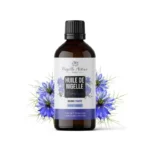
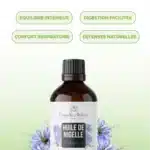
Ethiopian Black Seed Oil (Habachia) – 100 mL
Price range: 14,50 € through 27,50 €
In stock
Ethiopian Black Seed Oil, naturally rich in thymoquinone, ideal for supporting immunity and easy to incorporate into a seasonal supplement routine.
Active Ingredients in Habachia Black Seed Oil
Here are some of the potential benefits associated with black seed (Nigella sativa) and its oil, based on the findings of several scientific studies:
- Support for the immune response and modulation of certain markers involved in the body’s natural defence mechanisms (1)
- Possible improvement in certain symptoms associated with allergic reactions, particularly allergic rhinitis (2)
- Antibacterial and antifungal activities observed experimentally, alongside antioxidant properties that help combat oxidative stress (3)
- Possible improvement in certain digestive disorders and stomach discomfort, particularly in cases of dyspepsia (4)
- Potential skincare benefits, with promising results for certain skin conditions such as acne and eczema, as well as wound healing processes (5)
Please note: these points are provided for informational purposes only, based on the available scientific evidence. Black seed oil is not a substitute for a diagnosis, medical consultation or treatment prescribed by a healthcare professional.
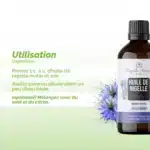
To enjoy its benefits, we recommend taking one teaspoon in the morning before breakfast and another in the evening before bedtime.
As its flavour is strong and bitter, you can mix it with a little honey to soften the taste without altering the oil’s properties.
Characteristics of Our Ethiopian Black Seed Oil
General Characteristics
The GoldandCare family guarantees you high-quality Black Seed Oil:
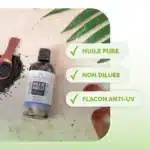
- Carefully selected raw materials, achieving a certified purity of 99.74% to 99.9%
- Black Seed Oil obtained exclusively through the first mechanical cold pressing (to preserve all its benefits)
- Unfiltered, it is left to settle naturally for several days to preserve its benefits as effectively as possible
- A product that has not been chemically treated or subjected to any chemical alteration
- Our oil is suitable for both cosmetic and food use
- A polyunsaturated fatty acid content of over 60% throughout the year, ranging from 61.1% to 62.7% depending on the sources. This concentration is among the highest throughout the year
The GoldandCare Guarantee for Optimal Storage
Black Seed Oil is extremely sensitive to light and oxidises very quickly. Most manufacturers and retailers seem to overlook this particular characteristic.
The result? Your precious Ethiopian Black Seed Oil quickly suffers from sunlight exposure when stored in traditional bottles!
That is why the GoldandCare family has chosen an opaque black bottle. It protects your exceptional Black Seed Oil from exposure to light and guarantees optimal storage conditions.
Why not start taking care of your health today? Don’t hesitate any longer: treat yourself to a quality product at the best price!
Notes
(1) Immune response support
- Kheirouri S, Hadi V, Alizadeh M. Immunomodulatory Effect of Nigella sativa Oil on T Lymphocytes in Patients with Rheumatoid Arthritis. Immunological Investigations. 2016;45(4):271-283.
- Hadi V, et al. Effects of Nigella sativa oil extract on inflammatory cytokine response and oxidative stress status in patients with rheumatoid arthritis: a randomized, double-blind, placebo-controlled clinical trial. Avicenna Journal of Phytomedicine. 2016;6(1):34-43.
- Salem A, et al. Effect of Nigella sativa on general health and immune system in young healthy volunteers: a randomized, placebo-controlled, double-blinded clinical trial. F1000Research. 2021/2023.
(2) Allergic reactions / allergic rhinitis
- Alsamarai AGM, Abdulsatar M, Ahmed Alobaidi AH. Evaluation of Topical Black Seed Oil in the Treatment of Allergic Rhinitis. Anti-Inflammatory & Anti-Allergy Agents in Medicinal Chemistry. 2014;13(1):75-82.
- Majeed A, et al. A randomized, double-blind, placebo-controlled study to evaluate the benefits of a standardized Nigella sativa oil containing 5% thymoquinone in reducing the symptoms of seasonal allergy. Medicine. 2024;103(32).
- He Y, et al. Meta-analysis of randomized controlled trials assessing the efficacy of Nigella sativa supplementation for allergic rhinitis treatment. Frontiers in Pharmacology. 2024.
(3) Antibacterial, antifungal and antioxidant properties
- Hossain MS, et al. A review of ethnobotany, phytochemistry, antimicrobial pharmacology and toxicology of Nigella sativa L. Biomedicine & Pharmacotherapy. 2021;143:112182.
- Kavyani Z, et al. The effect of Nigella sativa (black seed) on biomarkers of inflammation and oxidative stress: an updated systematic review and meta-analysis of randomized controlled trials. Inflammopharmacology. 2023;31(3):1149-1165.
(4) Digestive disorders and stomach discomfort
- Mohtashami R, et al. Efficacy and safety of honey based formulation of Nigella sativa seed oil in functional dyspepsia: a double blind randomized controlled clinical trial. Journal of Ethnopharmacology. 2015;175:147-152.
(5) Skin, acne, eczema and wound healing
- Soleymani S, et al. The effect of a hydrogel made by Nigella sativa L. on acne vulgaris: a randomized double-blind clinical trial. 2020.
- Yousefi M, et al. Comparison of therapeutic effect of topical Nigella with Betamethasone and Eucerin in hand eczema. Journal of the European Academy of Dermatology and Venereology. 2013;27(12):1498-1504.
- Nasiri N, et al. The Therapeutic Effects of Nigella sativa on Skin Disease: A Systematic Review and Meta-Analysis of Randomized Controlled Trials. 2022.
- Maghalian M, et al. The effect of Nigella Sativa emulgel on episiotomy wound healing and pain intensity in primiparous women: a triple-blind randomized controlled trial. PLOS ONE. 2025;20(6).
Informations
Informations complémentaires
| Weight | 0,3 kg |
|---|---|
| Nombre de Flacons | 1 huile, 2 huiles |
How Is Habachia Black Seed Oil Obtained?
Once again, this is something you should pay attention to if you want to find high-quality Habachia Black Seed Oil. The manufacturing process is precisely where you will encounter the most counterfeit products and oils with little genuine nutritional or therapeutic value.
There are several methods for producing pure, high-quality Habachia Black Seed Oil. We will focus on the best of them, the only method Gold&Care accepts for producing its vegetable oils: first cold pressing. Put simply, a mechanical press crushes the black seeds to extract their precious oil. Once extracted, the oil is left to settle for a few days until it reaches its final, ideal consistency.
But if this method is so simple, why do other methods exist? Quite simply because first cold pressing offers only the highest yield. Multiple pressing or hot pressing methods allow more oil to be extracted. However, this involves a significant loss of purity and quality.
Some manufacturers go even further to increase their yield. To do so, they mix black seeds with a neutral vegetable oil, such as sunflower oil. With very little black seed, it becomes possible to produce a large quantity of oil. This is not necessarily a bad thing if the mixture is prepared correctly and, above all, clearly declared.
Thanks to the first cold pressing method, Gold&Care guarantees a purity level of over 99.74% for its Habachia Black Seed Oils. In addition, the polyunsaturated fatty acid content of the oil remains above 60% throughout the year, ranging from 61.1% to 62.7% depending on the harvest.
Habachia Black Seed Oil: Why and How Should You Use It?
Black Seed Oil can be consumed orally or applied topically, depending on how you wish to use it.
When Should You Use Nigella Sativa?
Known scientifically as Nigella sativa, Habachia Black Seed Oil has numerous health benefits. It is generally known for its properties:
- Anti-inflammatory, helping to relieve joint and muscle pain (why not start soothing your rheumatic pain today?)
- Antioxidant, helping to slow down cellular ageing
- Analgesic, helping to prevent or reduce sensations of pain
- Antibacterial (useful for preventing bacterial growth)
- Hepatoprotective, protecting the liver (and helping it function properly every day)
The benefits mentioned above are the most widely known. However, Ethiopian Black Seed Oil has more than one trick up its sleeve! More recently, it has shown potential as part of the treatment of:
- Type 2 diabetes
- Asthma and certain other respiratory conditions
- Mild forms of high blood pressure
- Epileptic seizures
- Most skin conditions: eczema, psoriasis, itching, burns, chapped skin…
The list is long for a seed with so many benefits. Nevertheless, further studies are needed to integrate it more effectively into modern medicine and make the most of its properties.
How to Use It Every Day
You now know what Black Seed Oil can offer you and what its benefits are.
So why miss out? Taking one tablespoon of our Habachia Black Seed Oil every morning on an empty stomach is a real boost for your body. You can enjoy all its benefits over the long term, without risk!
For joint pain and skin conditions, massage it regularly into the affected areas to make the most of its benefits.
What we already know for certain is that Ethiopian Black Seed Oil, when taken regularly, guarantees better health alongside a varied and healthy diet.
We also know that it has proved effective against most skin conditions and has helped resolve many everyday discomforts and itching problems. And that is just what we currently know about Habachia Black Seed Oil.
Imagine everything we might discover about Habachia Black Seed Oil in the years to come. Why miss out?
And that's not all: discover right now why our Black Seed Oil stands out from the poor-quality products on the market!
The Origin of Habachia Black Seed Oil
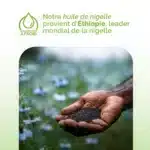
Habachia Black Seed Oil is produced from black seeds grown in Ethiopia, which have been used for centuries for their medicinal properties.
The Prophet – may the peace and blessings of Allah be upon him – referred to this seed as a remedy for every disease except death. Muslims attach particular importance to this hadith, as well as to supplications against pain when facing health problems.
Black seed mainly grows in:
* North Africa;
* the Near and Middle East;
* certain regions of Europe.
As with any plant, its properties and quality vary depending on the species, subspecies and origin. Ethiopian black seed is renowned for the quality of its seeds. The name "Habachia Black Seed Oil" refers exclusively to oil obtained from Ethiopian black seeds.
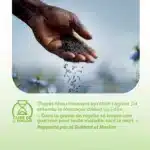
After a short flowering period, during which black seed honey can also be produced, the plant develops small black seeds. Also known as "black cumin", they are consumed as a spice, either whole or ground into powder, and have a bitter flavour with peppery notes.
Related products